How AI-augmented research lets us deliver six creative concepts where we used to deliver one
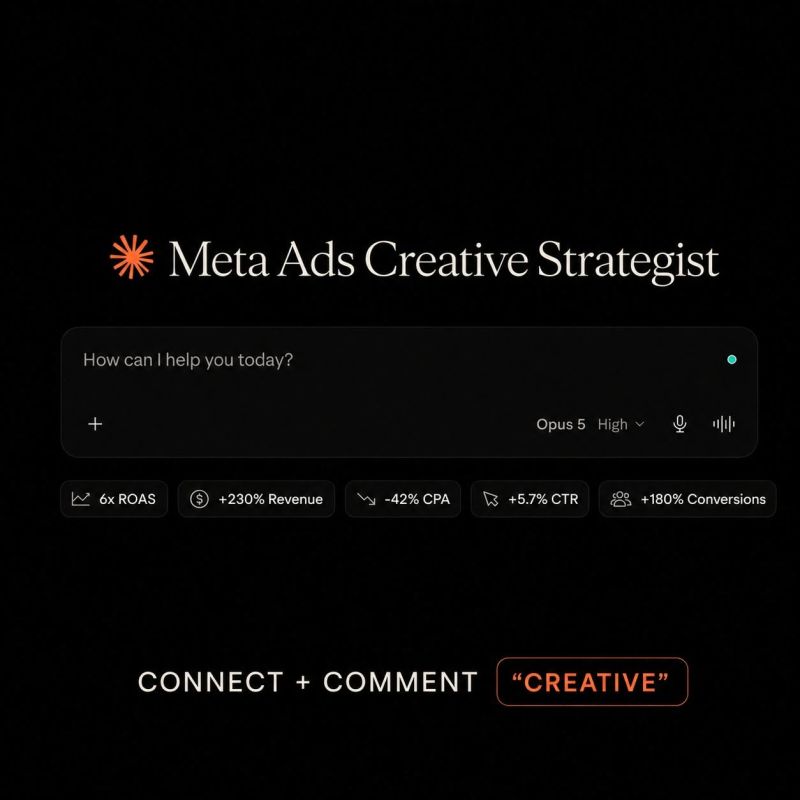
There is a workflow circulating in paid social circles that compresses a full week of competitor research into a single afternoon. The mechanics are straightforward: pull active ads from a public library, extract hook patterns and visual formats, cluster them by audience psychology, then generate ranked creative briefs with a test plan attached. What used to take twelve hours of manual scrolling and spreadsheet work gets done in fifteen minutes of structured prompting.
We pay attention to this kind of thing because the underlying logic applies well beyond Meta Ads. The EU bubble has its own competitive landscape — policy campaigns, membership drives, awareness pushes ahead of legislative moments — and the research problem is the same. Communication teams need to know what angles are landing with their audiences, what formats are getting traction, and how to brief creatives quickly enough to stay relevant. Most teams do that research slowly, informally, or not at all.
What a workflow like this actually changes is the ratio between insight and output. Instead of one rough concept per week, a team working with structured AI assistance can walk into a briefing with six fully-argued creative directions, each tied to observable signals rather than gut feeling. For an agency like ours, that shift matters in two ways: it raises the quality of what we bring to a pitch, and it frees up the time that used to go into research to go into craft instead.
The technique itself is not magic. It works because the prompting is disciplined — each step has a defined input, a defined output, and a clear handoff to the next step. That structure is what separates a useful AI workflow from an expensive autocomplete. When we build generative AI processes for clients or integrate them into our own creative strategy work, that is exactly the discipline we apply: define the task, constrain the output, make the result actionable.
If your team is still treating competitor research as a manual, once-a-quarter exercise, it is worth asking what you are leaving on the table. The tools to do it faster and more systematically are already available. The question is whether your workflow is set up to use them.
Originally posted on LinkedIn.
Parts of this article were produced with AI assistance, in line with our AI policy.
Want results like this for your team?
We train communication teams one-to-one on generative AI — hands-on, on your real work.
Discover the AI training